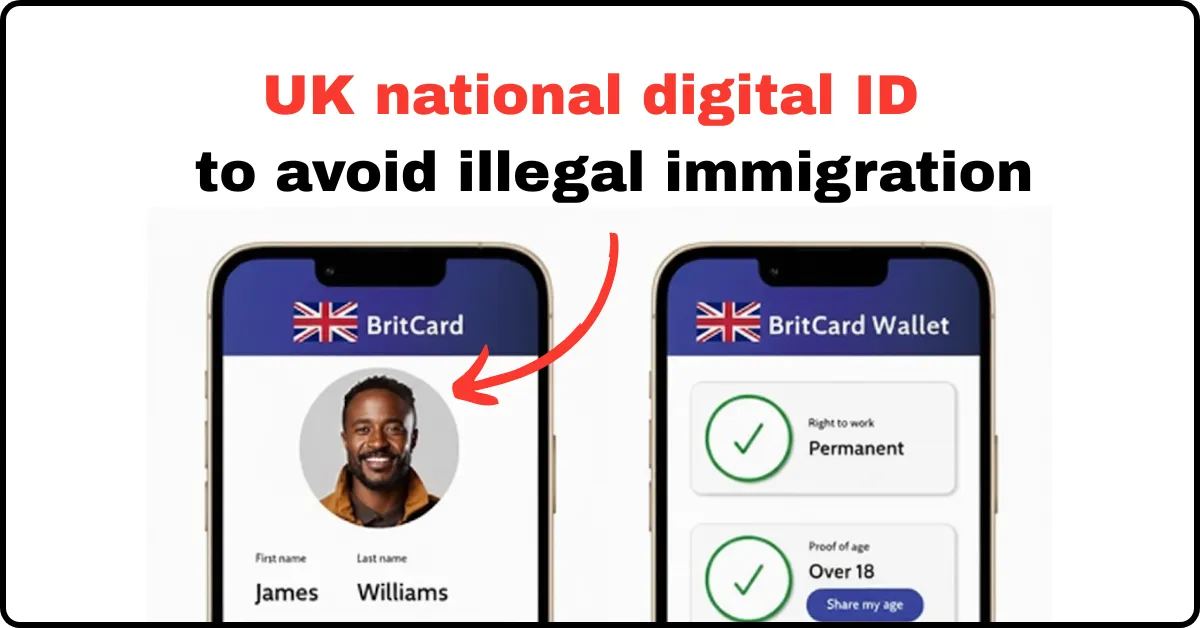
London, October 2025, The UK government has confirmed plans to roll out a free, phone-based national digital ID that will become mandatory for right-to-work checks before the end of the current Parliament. The move is being framed as part of efforts to curb illegal working and make access to services simpler and more secure.
What’s Been Announced
Downing Street said the new digital identity will be available to all UK citizens and legal residents. By the end of this Parliament, it will be compulsory for employment verification, ensuring that employers can only hire individuals with a verified right to work.
Officials say the scheme will be free to use, with alternative options for people without smartphones, ensuring inclusivity. The government stressed that there will be no legal requirement to carry the ID in daily life or to present it to police on demand.
How the Digital ID Will Work
- The ID will be stored on mobile phones.
- It will include basic identifiers such as name, date of birth, nationality or residency status, and a photo.
- If a device is lost or stolen, the credentials can be revoked and reissued.
- The government promises end-to-end encryption and privacy protections.
- People without smartphones will be able to access the system through non-digital alternatives.
https://www.gov.uk/government/news/new-digital-id-scheme-to-be-rolled-out-across-uk
Why Now?
Ministers argue that illegal working is a major driver of unlawful migration. By making digital ID compulsory for employment checks, they hope to remove opportunities for people to work without the right immigration status.
The initiative comes alongside stricter enforcement measures and heavier penalties for employers who hire workers illegally. Officials also note persistent challenges with forged or borrowed documents under the current system.
Impact on Employers and Workers
Employers will need to integrate the new system into hiring and compliance processes, moving away from paper-based checks or reliance on National Insurance numbers.
Legal experts caution that large-scale rollout could present challenges, and businesses will require clear guidance and technical support to ensure smooth adoption without creating hiring bottlenecks.
Privacy and Civil Liberties
To address public concerns, the government emphasized:
- Police will not have powers to demand the ID on the street.
- Individuals will not need to carry it at all times.
- Strong data protection standards will be applied.
However, civil liberties groups remain cautious, pointing to the UK’s historic rejection of physical ID cards and raising concerns about proportionality, data misuse, and error correction.
Timeline and Next Steps
- Public consultation: Scheduled for later this year to gather views on security, inclusivity, and technical design.
- Legislation: Expected in the next parliamentary session.
- Mandatory rollout: Full availability for citizens and residents, with compulsory use for right-to-work checks by the end of this Parliament.
What the ID Will Contain
The digital ID is expected to include:
- Personal identifiers (name, date of birth, photograph).
- Nationality or residency status.
This will serve as definitive proof of right-to-work eligibility, and potentially provide faster access to wider government services such as driving licenses, tax records, and childcare support.
Political and Market Context
Immigration remains a top issue for UK voters. Ministers present the digital ID as part of a broader migration and labor-market strategy, alongside tougher border controls.
Officials also highlight consumer benefits, suggesting the system will make it easier to securely access online government and private services.
Current System vs Digital ID
| Aspect | Current System | Digital ID Plan |
|---|---|---|
| Proof of right to work | Paper documents, NI numbers, and share codes vulnerable to misuse | App-based digital ID as definitive proof |
| Enforcement | Employer fines, manual document checks | Mandatory digital verification by end of Parliament |
| Accessibility | Applicants may struggle to present documents consistently | Free digital ID, with non-smartphone alternatives |
What to Watch
- Launch of the consultation process later this year.
- Draft legislation and its handling in Parliament.
- Employer integration guidance, particularly on error correction and data standards.
- Civil liberties debates, given the UK’s past skepticism toward ID systems.