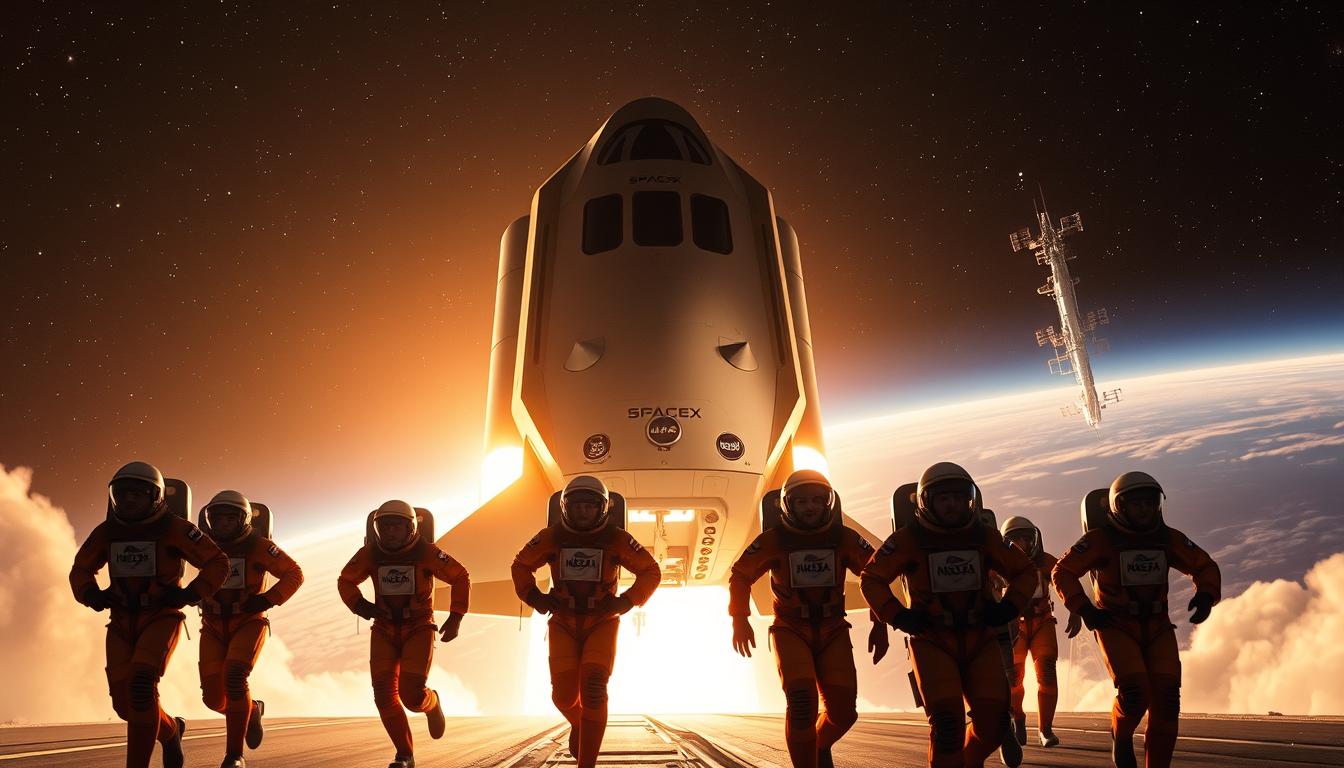
On March 14, 2025, history was made at Kennedy Space Center when SpaceX launched its Crew-10 mission, not for a routine rotation, but as an emergency rescue. Four NASA astronauts stranded on the International Space Station (ISS) due to a Soyuz capsule malfunction now have a safe way home, thanks to the partnership between SpaceX and NASA.
This mission demonstrates the growing importance of commercial spaceflight in crisis situations and highlights how international cooperation keeps astronauts safe when challenges arise in orbit.
Why a Rescue Was Needed
Earlier in March, a propulsion failure rendered the astronauts’ original return vehicle unusable. Additional cooling system glitches and software issues further complicated matters, forcing NASA to put contingency plans into action. While life aboard the ISS continued with health checks and system monitoring, the crew’s scientific work was paused until a safe return option could be arranged.
NASA, Roscosmos, JAXA, and ESA coordinated to keep critical ISS operations stable. Agencies provided everything from telemetry support to communication backups, ensuring the stranded astronauts remained safe until help arrived.
The Launch and Crew Details
The Falcon 9 rocket lifted off at 7:03 p.m. EDT from Launch Complex 39A, carrying a specially modified Dragon spacecraft equipped with additional life-support systems and reconfigured seating. The rescue crew consists of:
- Anne McClain (NASA, Commander) – Specialist in orbital mechanics and emergency protocols.
- Nichole Ayers (NASA, Pilot) – Trained in high-pressure mission procedures.
- Takuya Onishi (JAXA, Mission Specialist) – Robotics and docking expert.
- Kirill Peskov (Roscosmos, Flight Engineer) – Skilled in Russian systems integration and emergency operations.
Their mission timeline allows 24 hours to reach the ISS, 72 hours for transfer operations, and roughly six hours for re-entry.
Dragon’s Rescue Role
SpaceX’s Dragon spacecraft has long been a cornerstone of NASA’s Commercial Crew Program, but this mission pushes its design to new limits. For Crew-10, engineers installed enhanced life-support reserves, additional medical storage, and reinforced thermal shielding for re-entry. Dragon’s precision docking system and multiple redundancies ensure reliability during one of the most complex missions in its history.
Lessons from Space Rescue History
Space emergencies are not new. From the Apollo 13 crisis in 1970 to Soyuz MS-10’s aborted launch in 2018, past incidents have shaped today’s safety protocols. What has changed is the involvement of private companies like SpaceX, which now play a leading role in emergency preparedness. This mission underscores how decades of lessons have been applied to real-world rescue operations.
Global Reaction and Significance
The Crew-10 mission has captured worldwide attention, with millions following live coverage and the hashtag #SpaceXRescue trending globally. For many, it represents more than a rescue, it symbolizes how collaboration across borders and organizations can turn a potential disaster into a story of success.
Looking Ahead
The successful launch of Crew-10 sets a powerful precedent for the future of space exploration. It proves that commercial spacecraft can do more than transport crews; they can also serve as lifelines in emergencies. As humanity looks toward long-duration missions to the Moon and Mars, the ability to adapt quickly and respond to crises will be essential.
For NASA, SpaceX, and their international partners, this mission is not just about bringing astronauts home, it’s about building trust in the systems that will carry us further into the cosmos.