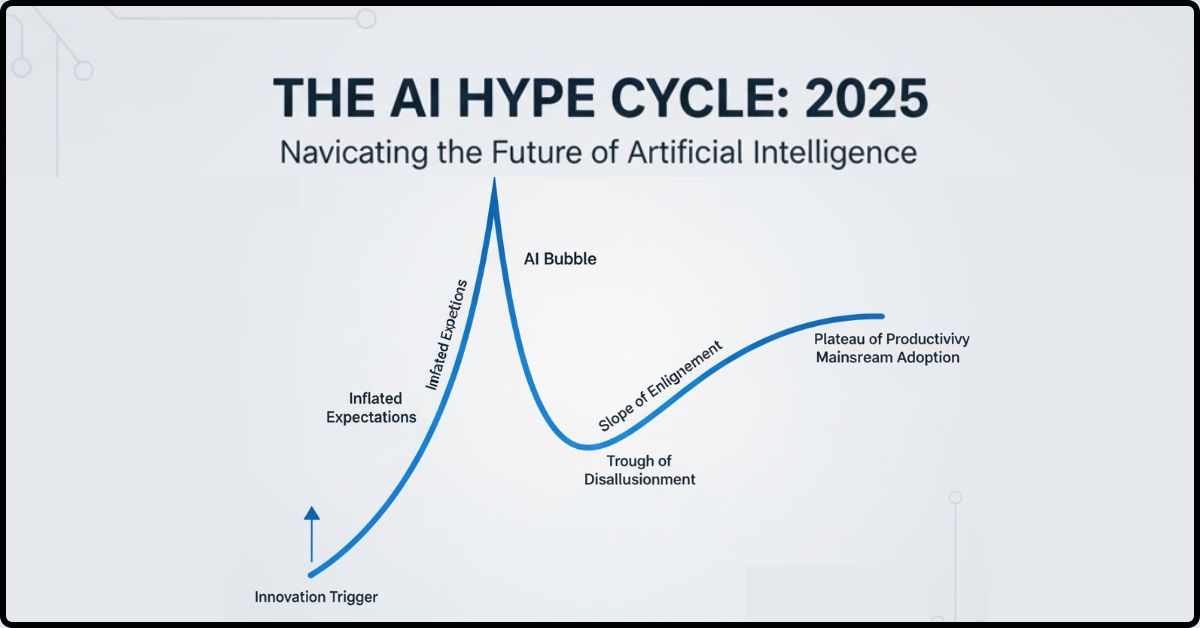
Artificial intelligence has become one of the most talked-about technologies of our time. From industry leaders predicting revolutionary change to record-breaking investments by big tech companies, the world seems captivated by AI’s potential. Yet, growing signs suggest that we may be entering a classic technology bubble, one that mirrors the dot-com era of the late 1990s.
Early Warnings From Industry Leaders
OpenAI’s CEO recently acknowledged that an “AI bubble” may already be forming. Meanwhile, an MIT report found that around 95% of generative AI projects in companies are failing to deliver expected results.
At the same time, six months ago Anthropic’s CEO predicted that 90% of coding would be automated by AI within half a year. That timeline has long passed, and yet, the reality tells a very different story.
Take large consulting firms such as Tata Consultancy Services (TCS), which employs about 600,000 people, with roughly two-thirds of them working in software development. If 90% of coding were truly automated, hundreds of thousands of developers would be out of work. In reality, TCS has reduced its workforce by only about 2–3%, far from the predicted 90%.
Even bold predictions from figures like Elon Musk, who claimed in mid-2024 that we would reach Artificial General Intelligence (AGI) by 2025, have yet to materialize. As of October 2025, AGI remains out of reach.
Lessons From the Dot-Com Bubble
The hype around AI today strongly resembles the internet boom of the 1990s. During that period, valuations for tech companies skyrocketed, and CEOs made sweeping claims about how the internet would change everything overnight. Eventually, in 2000, the dot-com bubble burst, sending many overvalued companies into bankruptcy.
Yet the technology itself didn’t disappear, it matured. After the dust settled, the internet became a foundational force shaping modern life. Similarly, AI is likely to follow a comparable trajectory: over-inflated expectations, market correction, and eventual long-term integration.
Unsustainable Investment Levels
A striking signal of this bubble is the surge in capital expenditure by major tech companies. In 2018, the combined annual capital investment by companies like Amazon, Google, and Meta was under $100 billion. Today, that number exceeds $400 billion, with much of it funneled into AI data centers, research, and infrastructure.
However, the revenue generated by AI services remains relatively small, around $12 billion. This vast gap between spending and returns is alarming. To illustrate: imagine a business spending $500,000 each year but earning only $12,000 in revenue. It can survive on investor enthusiasm for a while, but such a model is not sustainable indefinitely.
Valuations Detached From Reality
Another example of over-inflated optimism is Thinking Machines Lab, a startup founded by Mira Murati, a former OpenAI executive. Despite having no public product or paying customers, the company is reportedly valued at $10 billion, purely on the assumption that Murati’s reputation will lead to major breakthroughs. While confidence in talented founders is important, such valuations with no proven business model reflect speculative mania more than grounded investment.
Separating Hype From Reality
Like the early internet, AI is indeed a transformative technology, but not every claim about it is true, and not every company in the space will survive. Investors and professionals alike should learn to separate substance from hype.
Eventually, the market will correct itself: overvalued firms will fall, sustainable ones will persist, and AI will stabilize as a powerful but realistic part of our economy and daily life.
What This Means for Your Career
For professionals and students, this uncertainty can be confusing. Should you continue learning programming or tech skills if AI might automate them? The answer is absolutely yes.
It’s important to stay optimistic and adaptable. AI may automate repetitive coding tasks, but it won’t replace the creativity, problem-solving, and judgment of human developers. The best path forward is to use AI as a productivity tool, not a competitor.
There are two mindsets you can adopt:
- Fear and avoidance, assuming AI will take every job and therefore giving up on learning technical skills.
- Optimism and adaptation, viewing AI as an opportunity to work smarter, develop timeless skills, and integrate these tools into your workflow.
Only the second mindset will help you thrive in the long run.
Final Thoughts
AI’s hype cycle is reaching its peak. The technology is real, but the expectations are inflated. As history shows, bubbles eventually burst, but innovation doesn’t die. Just as the internet reshaped the world after the dot-com crash, AI will continue to evolve and profoundly impact our lives. The winners will be those who stay grounded, keep learning, and use AI to amplify their human potential.