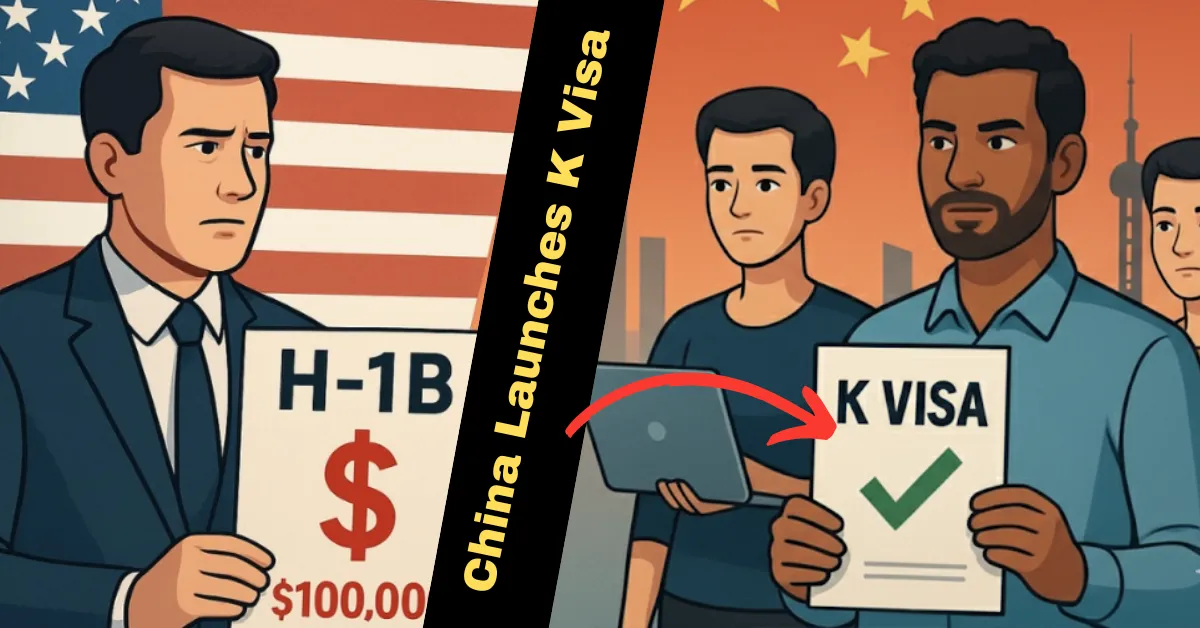
China has introduced a new K visa program aimed at drawing young foreign talent in science, technology, engineering, and mathematics (STEM). The initiative simplifies entry by removing the need for employer sponsorship at the application stage and highlights Beijing’s strategic push to boost innovation and international competitiveness.
The announcement comes as the United States updates its H‑1B visa rules, including a one-time $100,000 fee, creating a contrasting environment that could make China a more attractive destination for early-career STEM professionals.
What the K Visa Offers
The K visa targets “young foreign scientific and technological talents”, allowing recipients to engage in:
- Academic exchanges and collaborative research with universities and labs
- Entrepreneurship, including startups and tech incubators
- Business activities related to science and technology
- Education and cultural exchange connected to STEM fields
Unlike traditional skilled-worker visas, applicants do not need an invitation from a Chinese employer at the outset, lowering barriers for recent graduates and early-career professionals seeking global research or innovation opportunities.
Key Advantages
- No Employer Sponsorship Required: Simplifies the application process for young talent.
- Flexible Entry and Stay: Early commentary indicates multiple entries and adaptable durations.
- Broader Engagement: Supports research, entrepreneurship, and tech collaboration without immediate job offers.
Eligibility and Criteria
The program is aimed at early-career STEM graduates and professionals from recognized institutions. While exact details, including age limits, degree requirements, and work experience thresholds, have not yet been published, official guidance will be released through Chinese embassies and consulates.
Prospective applicants should monitor official channels for updates and prepare standard documentation, such as:
- Academic certificates and transcripts
- CVs highlighting research and projects
- Letters of intent from labs, universities, or incubators
- Financial proof, passport, photos, police clearance, and medical checks
How It Compares
K Visa vs. China’s R Visa:
- R visa: Targets senior or urgently needed specialists, typically requiring an employer invitation.
- K visa: Focuses on younger talent and removes the employer-invitation prerequisite, providing an early-career entry pathway.
K Visa vs. U.S. H‑1B:
- Sponsorship: H‑1B requires employer sponsorship; K visa does not.
- Cost: H‑1B now includes a new $100,000 fee; K visa is positioned around simplified processing rather than high fees.
- Certainty and Flexibility: K visa emphasizes flexible entry and stay, whereas H‑1B is lottery-based with capped numbers.
Implications for Global STEM Talent
For early-career STEM graduates from India, Southeast Asia, and Europe, the K visa presents an opportunity to gain experience in China’s AI, robotics, biotech, and advanced manufacturing sectors without relying on employer sponsorship.
Applicants should consider local factors such as:
- Language and cultural adaptation
- Regulatory and intellectual property frameworks
- Funding and startup ecosystems
- Residency registration and tax compliance
Strategic Outlook
China’s K visa complements broader national efforts to expand its innovation ecosystem and attract foreign talent to drive research, entrepreneurship, and commercialization in strategic technology sectors. Its success will depend on clear eligibility rules, transparent procedures, and high-quality opportunities in labs, incubators, and startups.
Quick FAQ
What is the K visa?
A visa for young foreign STEM professionals, designed to simplify entry for research, entrepreneurship, and technology collaboration.
Is employer sponsorship required?
No, applicants can apply without a domestic sponsor at the start.
When does it start?
The program launches in early October 2025; operational details will be published by Chinese embassies and consulates.
How long can one stay?
Initial reports indicate flexible durations, but exact limits will be clarified in official guidelines.
How does it compare to H‑1B?
Unlike the employer-sponsored and lottery-based H‑1B, the K visa offers simplified entry, more flexible stays, and avoids the recently introduced high fees.