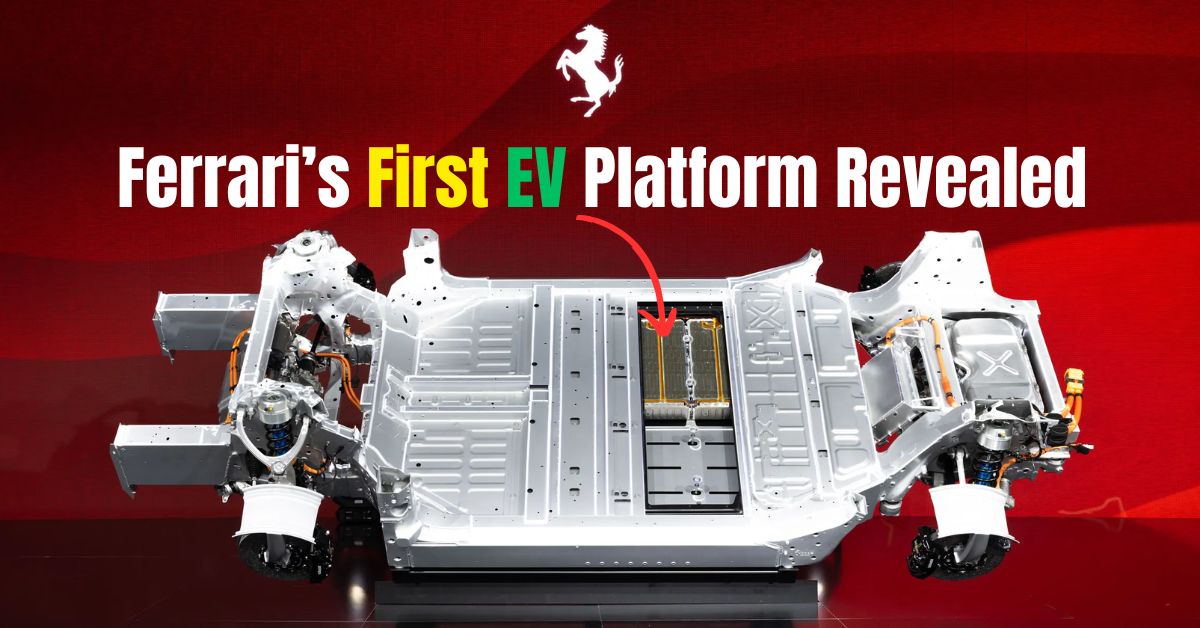
Ferrari has finally taken the wraps off the technology underpinning its first all-electric model, revealing a production-ready chassis and a proprietary quad-motor system developed entirely in-house. The move gives the world its first detailed look at how Maranello plans to electrify its iconic performance DNA, though it came hand-in-hand with a more cautious long-term business outlook that rattled investors.
The announcement offered a glimpse into the engineering heart of Ferrari’s upcoming EV, while a concurrent strategy update scaled back the brand’s 2030 electric-vehicle mix target. Together, the two signals, deep technical readiness but a measured market rollout, sent Ferrari’s shares into their steepest one-day decline since its IPO.
A Closer Look at What Ferrari Revealed
At its Maranello headquarters, Ferrari presented what it calls the Elettrica platform, showcasing a structural chassis with an integrated battery pack and dual e-axles, one at each end, housing four independent motors. The company withheld the car’s full exterior and cabin design for a later stage, part of a multi-event global rollout strategy leading up to launch.
This initial reveal was intentionally technical. Instead of design drama, Ferrari emphasized engineering depth: the motors, inverters, control software, and battery system that will define the car’s dynamic character. It was a presentation aimed more at technologists and enthusiasts than casual spectators.
Confirmed Technical Highlights
Based on briefings and on-site reports, the electric Ferrari will feature:
- Four motors delivering over 1,000 horsepower
- 0–100 km/h in roughly 2.5 seconds
- Top speed around 310 km/h
- High-capacity 122 kWh battery operating at 800–880 volts
- DC fast-charging up to 350 kW
- Estimated range exceeding 530 km
Ferrari also highlighted the use of recycled aluminum in the chassis and body structure to meet both performance and sustainability objectives.
Redefining the Sound of a Ferrari EV
One of the most distinctive innovations lies in the car’s sound engineering. Rather than relying on synthetic engine noise, Ferrari is developing an “authentic” acoustic signature by amplifying natural mechanical and aerodynamic tones generated by the powertrain itself. The system aims to recreate emotional feedback and connection, long a Ferrari hallmark, through real vibrations and dynamic sound modulation.
Drivers will also be able to fine-tune performance through paddle-controlled power modes, ensuring that even in an electric era, the Ferrari driving experience remains visceral and deeply personal.
Strategy Shift: A Balanced Road to 2030
Alongside the technical debut, Ferrari announced a recalibration of its long-term product mix. The company now expects about 20% of its lineup to be fully electric by 2030, with the remainder split between hybrids and internal combustion models.
Executives framed the adjustment as a “demand-driven evolution”, not a retreat, positioning electrification as an expansion of Ferrari’s portfolio rather than a wholesale replacement of its combustion heritage. The brand’s philosophy remains clear: performance and emotion first, technology as an enabler.
Updated Financial Guidance and Market Response
Ferrari also reaffirmed its near-term earnings strength but introduced more conservative 2030 targets, forecasting:
- ~€9 billion in annual revenue
- At least €3.6 billion in EBITDA
While the financial outlook underscores stability, analysts viewed the tempered long-range growth path and reduced EV mix as underwhelming. The result was a swift market reaction, shares in Milan and New York tumbled more than 10%, marking Ferrari’s sharpest single-day drop since going public.
Industry observers attributed the sell-off less to the EV itself and more to a perceived mismatch between Ferrari’s strong short-term momentum and its moderated long-term ambitions.
Why It Matters
Ferrari’s first electric chassis signals a new benchmark in the high-performance EV sector, with every critical system, from motors to control software, developed internally. It also demonstrates how the brand plans to bring emotion and feedback into the typically quiet world of electric driving.
For the ultra-luxury market, the message is clear: Ferrari will enter the electric era on its own terms, scaling only as technology and demand justify, not to chase volume or trends.
What Comes Next
Ferrari will continue its phased reveal strategy, with the full exterior and interior design expected to be shown ahead of initial customer deliveries beginning late next year and continuing into 2026, depending on market timing.
More details on pricing, trims, and homologation schedules are expected as the company transitions from development to production milestones under its current Capital Markets Day roadmap.
Quick QnA
Did Ferrari reveal the full car?
No. The company showcased only the chassis and powertrain. The full design will be revealed later.
Is Ferrari going fully electric by 2030?
No. The brand now targets around 20% EV share by 2030, with hybrids and combustion engines remaining core to its lineup.
Why did the stock drop so sharply?
Investors reacted negatively to Ferrari’s more modest long-term guidance and lower EV targets, even though the EV technology itself drew widespread acclaim.