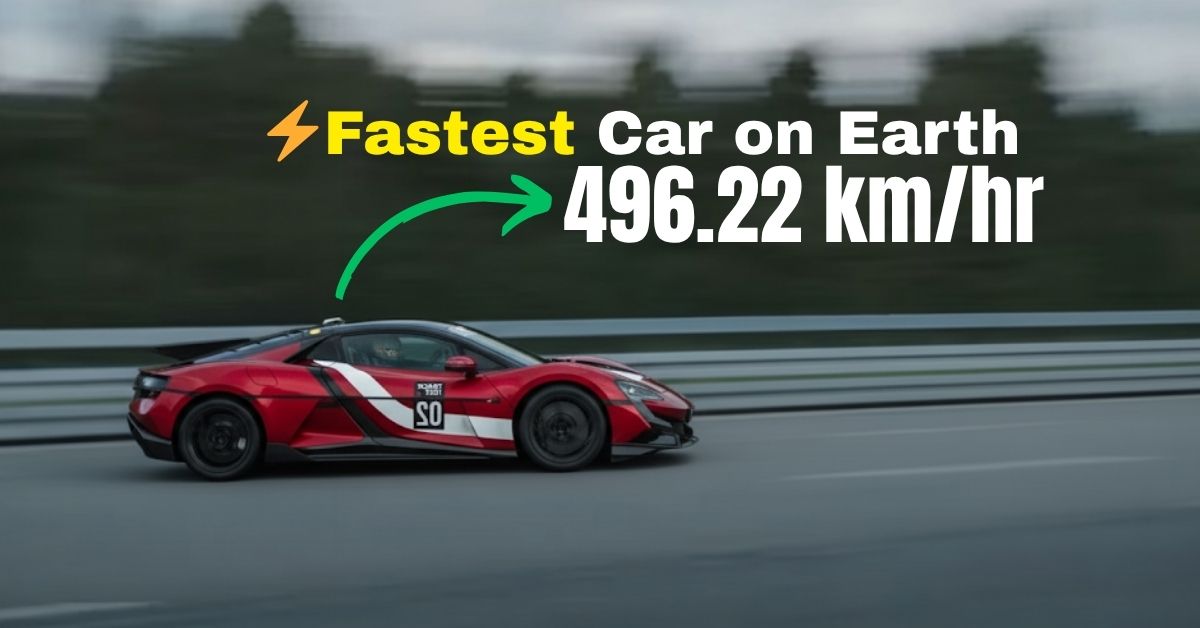
September 2025 Germany: BYD’s Yangwang U9 Xtreme (U9X) has officially entered the global speed record conversation after achieving an astonishing 496.22 km/h (308.4 mph) at Germany’s ATP Automotive Testing Papenburg facility. The figure, confirmed through coverage from outlets including Top Gear and Pandaily, positions the electric hypercar as the fastest production car in the world, at least in one-directional top-speed terms.
A Record-Breaking Run
In mid-September 2025, BYD’s performance division conducted a series of high-speed tests at ATP Papenburg’s high-banked oval track. During these runs, the Yangwang U9 Xtreme reached 496.22 km/h, surpassing Bugatti’s 2019 Chiron Super Sport 300+ milestone of 304.77 mph (490.48 km/h).
Top Gear reported the record, confirming that the speed was measured under official conditions, and described the U9X as “the new leader of the production-car speed charts.” Pandaily also covered the event, noting that BYD presented the U9X’s performance as a direct challenge to both combustion-engine and electric hypercar benchmarks.
Venue and Driver
The test took place at ATP Papenburg, one of Europe’s premier proving grounds for high-speed testing. Known for its long straights and steep banking, the track allows for controlled validation of vehicles exceeding 400 km/h.
At the wheel was German racing veteran Marc Basseng, who detailed his methodical buildup to the 308.4-mph pass. According to his Top Gear interview, each attempt gradually increased in pace until the record run was achieved. Basseng highlighted how tire temperatures, track banking limits, and stability margins dictated the strategy, all crucial when approaching 500 km/h.
What This Record Means
The U9X’s 496.22 km/h achievement dethrones Bugatti’s 2019 one-way record in the production-car vmax category. However, it’s important to note that BYD and Top Gear both emphasize this as a single-direction run, not a two-way average.
That distinction matters. For context, Koenigsegg’s Agera RS still holds the official two-way production-car record with an average speed of 447.19 km/h (277.87 mph), achieved in Nevada in 2017.
In short:
- U9X currently leads the one-way top-speed conversation.
- Agera RS remains the two-way average record holder, where both directions are measured to cancel wind and gradient effects.
Inside the U9 Xtreme: Power and Innovation
According to Top Gear, the Yangwang U9 Xtreme produces an astonishing 2,978 bhp (over 3,000 PS) from four electric motors, each capable of spinning up to 30,000 rpm. It also debuts a 1,200V electrical architecture, making it the first production platform to exceed the 800V systems seen in most performance EVs today.
This architecture, combined with BYD’s Blade Battery, supports a 30C discharge rate, meaning the pack can deliver immense bursts of power with stable thermal control. Pandaily adds that the car’s power-to-weight ratio targets 1,217 PS per ton, highlighting the U9X’s extreme engineering focus.
Watch Video Here
Source: BYD Youtube Channel
Tyres, Safety, and Testing Protocols
BYD collaborated with Giti Tire to create the GitiSport e·GTR² PRO tires, semi-slicks reinforced with aramid fibers to maintain stability at speeds approaching 500 km/h. These tires were drum-tested at 500 km/h for nine minutes, ensuring durability far beyond the brief top-speed window achieved on the oval.
Top Gear also reported that the U9X weighs roughly 2,480 kg, with extensive revisions to tire dimensions, aerodynamics, and cooling systems. These measures allowed the car to safely reach vmax conditions without compromising thermal stability or electrical integrity.
Track Prowess Beyond Straight-Line Speed
Beyond its top-speed heroics, the U9 Xtreme reportedly clocked an impressive 6:59.157 lap time at the Nürburgring Nordschleife, according to Pandaily. This figure places it among the quickest production vehicles ever to lap the 20.8-km circuit, underscoring that the U9X isn’t just built for speed runs but also for track performance.
Only 30 examples of the Yangwang U9 Xtreme will be produced globally, making it one of the rarest hypercars on the market. Each unit carries extensive hardware and software upgrades compared to the standard Yangwang U9, including bespoke aero tuning and motorsport-grade systems.
How It Stacks Up
| Vehicle | Top Speed | Context | Year |
|---|---|---|---|
| Yangwang U9 Xtreme (U9X) | 496.22 km/h (308.4 mph) | One-way run at ATP Papenburg; presented as fastest production car | 2025 |
| Bugatti Chiron Super Sport 300+ | 490.48 km/h (304.77 mph) | One-way run at Ehra-Lessien; TÜV verified | 2019 |
| Koenigsegg Agera RS | 447.19 km/h (277.87 mph) | Two-way average; verified production record | 2017 |
What Comes Next
Marc Basseng hinted in Top Gear’s report that the car still had “a little more room” for improvement, suggesting a potential follow-up attempt under ideal conditions. BYD’s messaging aligns with this, emphasizing the U9X’s current result as a milestone for production-car performance while keeping the door open for a future two-way verification.
Given that BYD previously achieved a 472.4 km/h electric-vehicle benchmark just weeks earlier, the company appears committed to pushing high-performance EV limits further in 2025.
Quick FAQ
Is the 496.22 km/h run an official record?
It’s recognized by major outlets as the fastest production-car top speed to date, but classified as a one-direction vmax, not a certified two-way average.
Who drove the car?
The record run was piloted by German racer Marc Basseng, a seasoned endurance and GT driver.
How does it compare with Bugatti’s run?
At 308.4 mph, the U9X edges past Bugatti’s 304.77 mph one-way result from 2019, setting a new headline figure in the top-speed hierarchy.
What about the Koenigsegg Agera RS record?
Koenigsegg’s 447.19 km/h two-way average remains the most widely recognized verified record under official protocols.
How many U9X cars will be made?
BYD plans a limited production of 30 units globally, emphasizing exclusivity alongside its performance credentials.